Most living rooms come with one ceiling fixture and a switch by the door. It floods the room with flat, even light and makes everything look slightly worse than it does in daylight. If that sounds familiar, you have more options than you think. You can skip the ceiling entirely and build a lighting scheme from the floor up, using fixtures you can plug in, move, and unplug again whenever the room changes. Done well, it makes a living room feel bigger, softer, and far more usable in the evening.
Start With Layers, Not Lamps
Lighting a room is less about finding one perfect fixture and more about stacking three kinds of light on top of each other.
- Ambient light washes the room so you can move around safely without squinting.
- Task light is aimed at what you're doing: reading, knitting, chopping something at a side table, working on a laptop.
- Accent light is decorative. It grazes a wall, picks out a shelf, or glows low behind a plant.
A single ceiling light tries to be all three and fails at each. Separate fixtures, each doing one job, give you control. You can have the corner lamp on while you read, the sconces dimmed for a film, and the table lamp off entirely.
Walk the Room Before You Buy Anything
Fifteen minutes with a notepad saves a lot of returns. Note where the outlets are, including the awkward one behind the sofa. Look at where people actually sit and where they put drinks down. Then find the dark corners, because those are the ones that make a room feel small at night.
Pay attention to height, too. A living room with nothing lit below waist level feels clinical; one with nothing lit above it feels like a restaurant booth. The goal is a spread: light near the floor, light at seated eye level, and light up on the walls. Once you see your room that way, the shopping list writes itself.
Use Floor Lamps as the Backbone
Floor lamps do the heavy lifting when there's no ceiling light to rely on. Place one in the corner that always looks gloomy, ideally slightly behind and to the side of the main seating rather than directly in front of it. Light coming from the side and from behind softens faces and makes the room feel deeper.
For a sofa, a floor lamp with the shade sitting at or just below eye level when you're seated is the most useful height. Higher than that and the bulb glares; much lower and it only lights the carpet. An arc lamp can swing over a coffee table or a reading chair, but check that the reach actually clears the seat and that the base is heavy enough that a bumped elbow won't tip it.
Two floor lamps worth having
One uplight or torchiere pointed at the ceiling gives a broad, indirect glow that reads as ambient light. One adjustable reading lamp with a directional head covers your task needs. Together they handle most of what a ceiling fixture used to do, and neither one is fixed in place.
Wall Sconces Without an Electrician
Sconces are the layer most people skip, and they're the one that changes a room most. Mounted at roughly 150 to 170 cm from the floor, they put light on the wall at head height, which lifts the whole space. Flank a piece of art, sit a pair either side of a sofa, or put a single one above a side table where there's no room for a lamp.
You don't need wiring in the wall. Plug-in sconces run a cord down to the nearest outlet, and fabric cord covers or a slim channel painted the same colour as the wall make the cable all but disappear. Rechargeable sconces need no cord at all and are excellent in rented flats or on walls with nothing nearby; just keep an eye on charging them, because a dead sconce is worse than no sconce.
Choose shades that direct light up and down rather than straight out. A sconce that stares at you across the room is a nuisance. One that grazes the wall is an atmosphere.
Table Lamps and the Low Glow
Table lamps are the easiest layer to get right and the easiest to get wrong. The classic mistake is a lamp that's too small for its table or a shade that sits below the sightline of anyone sitting nearby, so the bulb shows. As a rule, the bottom edge of the shade should land around eye level when you're seated next to it.
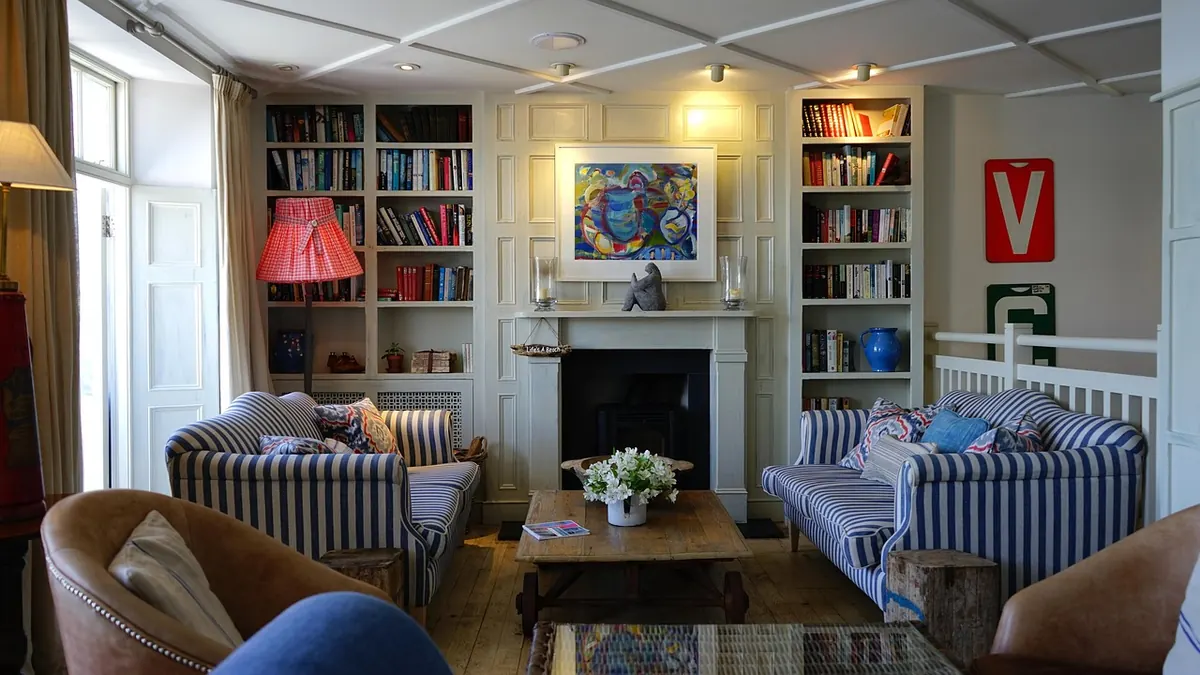
Put lamps where hands already go: the end of the sofa, the console behind it, the shelf beside the armchair. A pair of matching lamps on a console or either side of a doorway creates rhythm and makes a room look considered without looking staged. A single small lamp on a bookshelf, glowing through a linen or paper shade, does more for evening mood than most decorative objects.
Shade material matters as much as the lamp. Opaque metal shades throw a tight pool of light and suit task work. Linen, cotton, and paper diffuse light in every direction and suit everything else.
Bulbs, Warmth, and Dimming
You can buy beautiful fixtures and ruin them with the wrong bulbs. For a living room, look for warm white bulbs around 2700K to 3000K. Anything above 3500K starts to look like an office corridor once the sun goes down. Match your bulbs across the room so no corner reads blue while another reads golden.
On brightness, a rough guide for relaxed living rooms is 10 to 20 lumens per square foot spread across all your fixtures, not concentrated in one. That usually means a mix of 450 to 800 lumen bulbs rather than one very bright one. If you want a single number: an 800 lumen bulb is roughly the old 60W incandescent.
Dimming is the single biggest upgrade. A dimmable bulb and a compatible dimmer, or a smart bulb paired with a wireless remote, lets you take the room from bright enough to tidy up down to a low glow for late evening. Put the lamps you use most on smart plugs or a single switched extension so you're not crawling behind furniture to turn four things off.
A Setup You Can Copy Tonight
- Put a bright uplight or torchiere in the darkest corner and turn it on.
- Add a reading floor lamp to the side of the main seat, angled over the page, not over the head.
- Place a table lamp at each end of the sofa or on the console behind it.
- Add one sconce or a pair on the largest blank wall, at about 150 to 170 cm from the floor.
- Swap every bulb to warm white and dim anything you can.
- Turn the ceiling light off and leave it off.
Check the Room After Dark
Do the final test at night, with curtains closed, standing in the doorway. Look for hard shadows, hot spots on the wall, and any corner that still reads as a black hole. Sit where you usually sit and check whether the light falls on your book, not into your eyes. Then turn everything down low and see if the room still feels generous rather than dim.
Adjust from there. Move a lamp half a metre, swap a shade, angle a head. Layered lighting is never finished in one afternoon, and that's the pleasure of it: every fixture is a dial you can turn until the room finally feels like yours.
Photo: VariousPhotography / Pixabay